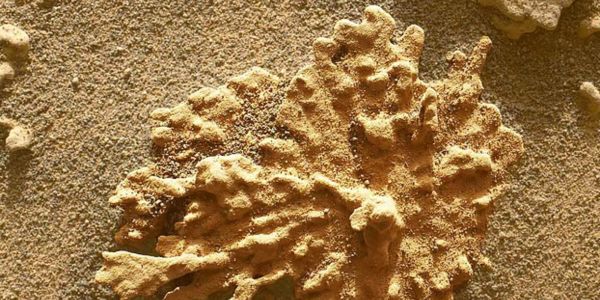
NASA’s Curiosity rover, which has been exploring the Red Planet since 2012, has sent back images of a fascinating geological feature: a rock that bears a striking resemblance to deep-sea coral found on Earth.
Although the rock measures only a few centimeters in size, its intricate, branching structure has sparked immense curiosity among the scientific community. The rover captured the close-up images using its powerful Mars Hand Lens Imager (MAHLI), located at the end of its robotic arm.
While the formation looks like biological coral, scientists have clarified that it is not a fossil nor evidence of ancient life. Rather, it is the result of a complex geological process that took place over billions of years.
The Science Behind the ‘Coral’
According to planetary geologists, this peculiar shape is a classic example of mineral deposition and differential erosion. The formation process likely occurred in two main stages:
-
Mineral Deposition: Billions of years ago, when liquid water existed on Mars, it flowed through cracks and fractures in the bedrock. As the water moved, it deposited minerals within these cracks. Over time, these minerals hardened and cemented together, becoming more durable than the surrounding rock.
-
Wind Erosion: After the water dried up, the Martian wind took over. For eons, strong winds eroded the softer surrounding rock and sand. However, the mineral-filled cracks—being harder—withstood the erosion. The result is these “branch-like” structures standing tall while the rock around them has worn away.
A History of Strange Shapes
This is not the first time the Curiosity rover has stumbled upon weirdly shaped rocks. The Martian surface, shaped by wind and ancient water, is a gallery of geological oddities.
-
The ‘Flower’ Rock: Previously, the rover found a rock resembling a blooming flower.
-
The ‘Ball’ and ‘Spikes’: Other findings include spherical marbles and spike-like protrusions.
Planetary scientists note that similar formations can be found on Earth, particularly in desert landscapes or coastal regions where wind and salt erosion sculpt rocks into fantastic shapes.
Significance of the Discovery
While this specific rock does not change the fundamental understanding of Mars, it adds another piece to the puzzle of the planet’s wet past.
“This coral-shaped rock is yet another confirmation that the Martian environment was once much more active and dynamic, with the presence of liquid water playing a key role in shaping its geology,” scientists noted.
Curiosity’s Ongoing Mission
Currently, the Curiosity rover is continuing its mission to analyze the chemical composition of the Martian soil. By collecting small data points like this ‘coral’ rock, NASA hopes to reconstruct the history of how Mars transformed from a potentially habitable, wet world into the dry, frozen desert it is today.